Hochleistungs-Füllstoffe für Elastomere aus Plasmalyse von Kunststoff-Abfällen
The project develops a sustainable substitute for industrial carbon black from plastic waste using a plasma-based process. This replaces fossil raw materials and significantly reduces CO2 emissions. The recovered fillers are intended for use in elastomers such as tires and technical rubber products.
High-performance industrial carbon blacks have served for decades as the primary reinforcing fillers in elastomeric tire compounds, where their incorporation into the polymer network enhances key mechanical and functional properties such as strength, stiffness, hardness and abrasion resistance. They also prevent the buildup of static charge in seals and extend the service life of products filled with industrial carbon black.[1]
@ Fh IWKS
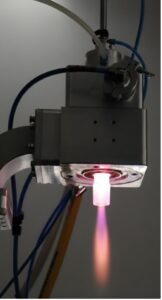
However, the production of conventional carbon black is energy-intensive and associated with significant environmental impacts, while its use continues to increase according to current market data. Since industrial carbon black is predominantly produced from petroleum fractions or natural gas, its CO2 balance is unfavorable, with emissions of 2.6 kg CO2-eq per kg.[2] This study introduces GreenPlasmaCarbon as a novel, sustainable filler alternative aimed at mitigating the unfavorable CO2 balance of conventional industrial carbon black and contributing to improved environmental sustainability. Using a scalable microwave-based plasma process, carbonaceous filler materials with comparable performance characteristics to industrial carbon black can be produced from large-scale plastic waste streams.
The underlying premise of this work is the enormous volume of polymer waste, as nearly 6 million tonnes of plastic waste are generated annually in Germany alone. Despite increasingly advanced sorting and recycling technologies, more than 60 % of this waste is subjected to thermal recovery.[3] Although the pyrolysis of end-of-life tires has gained increasing relevance as a technology for recovering hydrocarbon fractions in recent years, the soot-like residues recovered from this process (recovered carbon black, rCB) have thus far failed to provide the properties required for effective mechanical reinforcement in high-
performance elastomers. The aim of this work is to develop PlasmaCarbon with performance characteristics comparable to those of conventional industrial carbon blacks, thereby providing a viable alternative for their replacement. This approach represents a significant step toward a sustainable and resource-efficient circular economy by reclassifying waste streams as valuable feedstocks and reintegrating them into material cycles. In addition, it contributes to reducing dependence on fossil resources and improving the overall CO2 balance. Consequently, the project demonstrates the potential of establishing a high-performance secondary raw material for elastomers as a sustainable alternative to industrial carbon black, while simultaneously advancing the fundamental understanding of how process parameters, particle morphology, and surface functionalization can be precisely controlled within a plasma-based synthesis route.
References:
- Fan, Y.; Fowler, G.D.; Zhao, M.: The past, present and future of carbon black as a rubber reinforcing filler – A review. 2020. Journal of Cleaner Production 247, 119115.
- Eggleston, H.S.; Buendia, L.; Miwa, K. et al.: IPCC Guidelines for National Greenhouse Gas Inventories. 2006. 3, 3.
- Umweltbundesamt; Article: Kunstoffabfälle. 2023.