Scrap-tolerant design of high-strength GJS recycling alloys
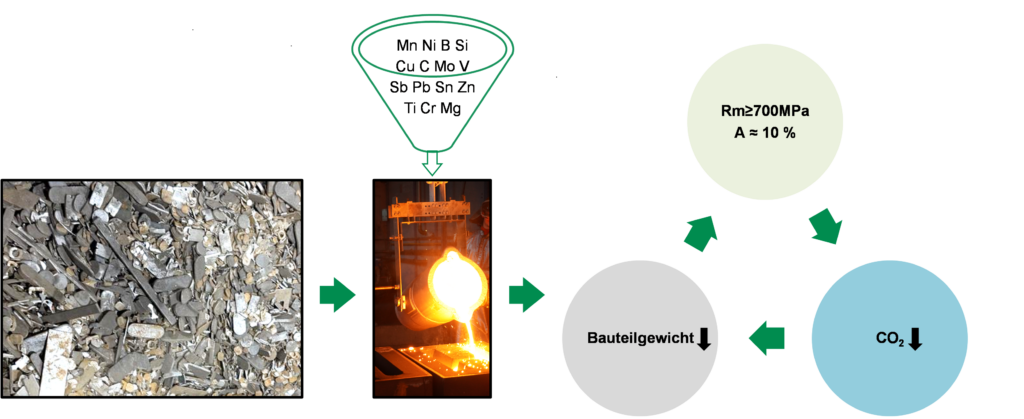
The STAR project develops new high-strength cast iron alloys that can be reliably produced using recycled scrap. High strength and sufficient ductility are specifically combined. This reduces material usage and significantly improves the circularity of ductile cast iron (GJS).
STAR focuses on the development of scrap-tolerant, high-strength GJS recycling alloys for the future use of more complex scrap grades in ductile iron production. The project investigates how accompanying, detrimental and trace elements, particularly from high-manganese and microalloyed steels, affect the microstructure, process stability and mechanical properties of GJS.
The project has two linked goals: improving the strength-ductility balance of as-cast GJS and maintaining stable material properties when scrap with higher contents of critical accompanying elements is used. The target is an as-cast GJS material with a tensile strength of at least 700 MPa and an elongation of approximately 10 %. This property combination can enable cast components, for example in automotive applications, to be designed with reduced wall thickness and lower component weight.
Detrimental elements introduced through complex scrap grades, including titanium, vanadium, molybdenum, niobium, manganese and other relevant elements, must be considered because, above critical limits, they can negatively affect graphite morphology, metallic matrix formation, carbide formation, process stability and mechanical properties. STAR therefore aims to define alloy concepts and permissible element contents that combine high mechanical performance with a broader and more flexible use of scrap.
The experimental work includes the casting of GJS alloys with defined chemical compositions derived from statistical trial plans, followed by mechanical testing and detailed microstructural characterization. A central result of the project will be a material model for the targeted use of new scrap grades in GJS production. The model will combine experimental alloy data, chemical analyses, microstructural information, mechanical properties, scrap-related element data and industrial validation results. The development of this material model is based on the combination of experimental and digital methods. Design of Experiments, Response Surface Methodology, model-based evaluation, data-driven approaches and machine-learning-based methods are used to capture and evaluate the effects of individual alloying and trace elements. This combined approach provides the basis for model-based alloy development and for optimizing scrap use while maintaining process stability and reliable material performance. It is intended to support the prediction of GJS properties under varying scrap compositions and to help define suitable composition ranges and permissible limits for detrimental elements.
Under industrial conditions, the project aims to enable the use of at least 25 % high-manganese and microalloyed scrap without losses in process stability or material performance. STAR therefore contributes to a broader scrap base, digital alloy development and the experimental validation of new GJS materials. It also supports supply security, circular economy, resource conservation and the reduction of greenhouse gas emissions, with the objective of achieving material and CO2 savings of at least 15 %.
A further focus is the structured handling of the generated research data. Experimental plans, chemical compositions, process data, mechanical properties and metallographic results will be documented and prepared according to the FAIR principles. Integration into the Platform MaterialDigital (PMD) supports traceability, reusability and future model-based alloy development.
The project brings together academic, industrial and recycling expertise. The participating partners are Technical University Clausthal – Institute for Metallurgy, Foundry Technology Department, FONDIUM Group GmbH, FONDIUM Mettmann GmbH, and RWP GmbH; Westrecycling GmbH is involved as an associated partner.
Technical University Clausthal contributes DoE-based alloy development, casting trials, mechanical testing, microstructural analysis and validation. FONDIUM contributes industrial casting expertise, production data and validation under practical conditions. RWP contributes modelling, simulation and data-based prediction methods. Westrecycling supports the project with knowledge of scrap markets, scrap availability and relevant scrap compositions. Together, the partners aim to transfer the developed scrap-tolerant GJS alloy concepts and material models toward industrial application. The resulting alloy concepts and model-based recommendations are intended to support foundries in selecting suitable scrap grades, defining permissible element limits and maintaining stable GJS properties despite increasing scrap variability.